
Quick answer: Solo travel in Thailand works best with two to three weeks split across Bangkok, Chiang Mai, and one island stretch. The budget runs roughly $25 to $50 USD a day for hostel to mid range travel. Backpacker infrastructure here is some of the most established in Asia, hostels, transport, and a built in solo traveller community make it a genuinely easy country to navigate alone.
- Best first time regions: Bangkok, Chiang Mai, and one island stop (Koh Tao or Koh Phangan)
- Daily budget: roughly $25 to $50 USD for backpacker to mid range travel
- Best season: November to February for cooler, drier weather across most of the country
- Grab and the BTS/MRT solve most in city transport headaches
- Solo doesn’t mean alone, hostels here are built specifically around making that easy
Why Thailand Is One of the Best Solo Destinations in Asia
Here’s the thing nobody tells you before you land: it’s a little overwhelming for about 48 hours, and then it just isn’t anymore.
The airport feels like a lot. The streets feel like a lot. Figuring out how to even ask for the check can feel like a full time job on day one. And then, almost out of nowhere, you’re ordering food without hesitating, hopping on the BTS without opening Google Maps every ten seconds, and deciding your next stop without needing anyone’s permission or company to make it happen.
That’s the magic of Thailand, honestly. Decades of tourism infrastructure means independent travel here is about as smooth as it gets, transport, accommodation, well worn routes between cities, all of it just works.
But “Thailand is solo friendly” is only half the answer, isn’t it? What you actually want to know is more specific. What’s this going to cost you? Where do you even start? What’s the easiest way to hop between places? Which safety tips are actually worth remembering, versus the ones that just sound scary? And when does it make more sense to let someone else handle the logistics?
That’s what this guide is for. Real numbers, real routes, no vague “explore the culture!” filler.
Best regions and cities for first time solo travellers
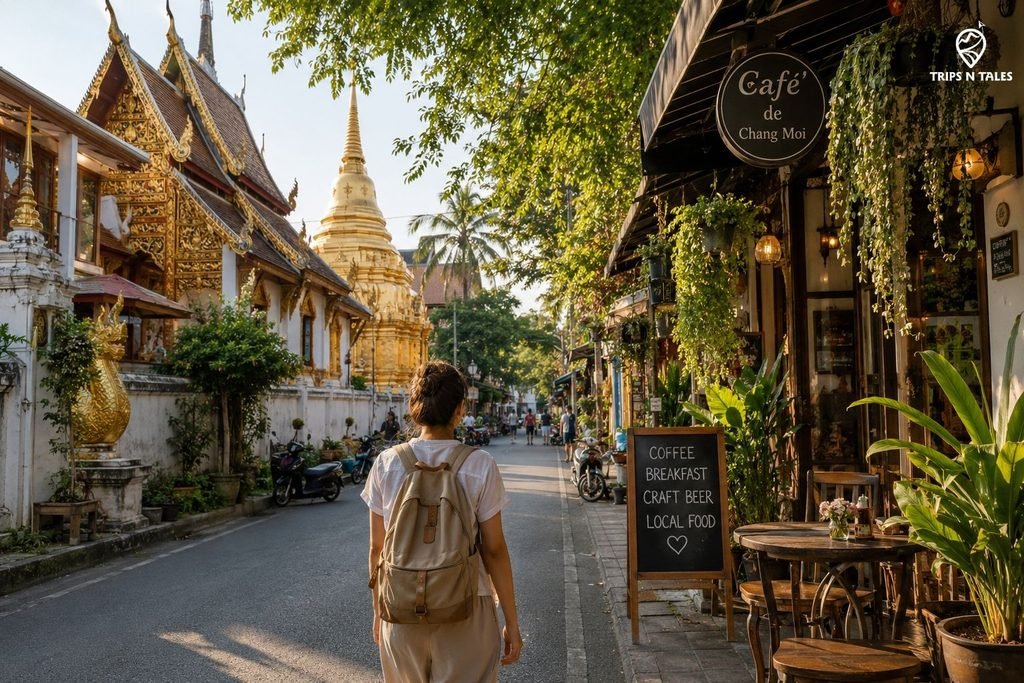
You don’t need to cram the entire country into two weeks, and honestly, trying to burn you out fast. These five spots consistently deliver the best solo experience.
- Bangkok is where you start, no question. The BTS and MRT make getting around ridiculously easy from day one, Khao San Road gives you that classic backpacker social scene everyone talks about, and if you want a breather from the tourist trail, Chinatown and Ari feel like an entirely different, quieter city.
- Chiang Mai might just be the most solo friendly city in the country. The Old City is fully walkable, temples and cafes and markets are all within reach, and the digital nomad crowd mixing with backpackers means meeting people happens almost without trying.
- The islands all have their own personality, so pick based on your vibe. Koh Tao is for anyone who wants to dive, the dive schools basically hand you a friend group within days. Koh Phangan is so much more than Full Moon Party chaos, there’s a genuine wellness and yoga scene if that’s more your speed. Koh Lanta is the slow, quiet option, beach time minus the party noise.
- Pai is a tiny mountain town outside Chiang Mai where time basically stops. You’ll recognize the same faces within two days, it’s a strange, lovely kind of small town energy for somewhere you’re only visiting.
- Ayutthaya makes for a perfect easy day trip from Bangkok. Ancient ruins, a bicycle, zero pressure. A great one to knock out solo without overthinking it.
How much does solo travel in Thailand actually cost?
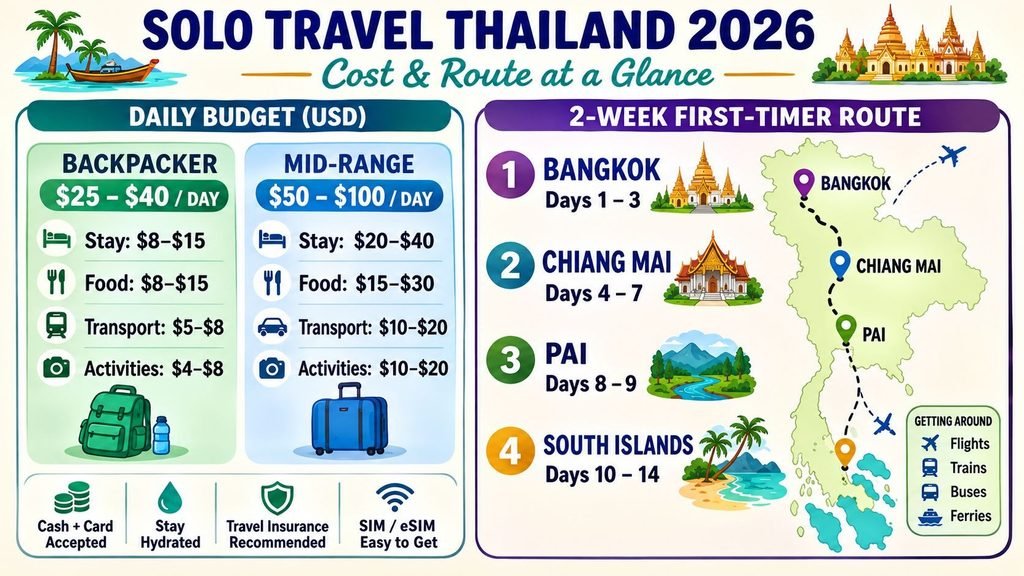
Let’s talk numbers, because vague budgeting advice helps nobody.
Backpacker mode (hostel dorms, street food, local transport) runs you $25 to $40 USD a day. Want a bit more comfort, private rooms, a nicer meal here and there, taxis instead of squeezing into a songthaew? That’s more like $50 to $100 USD a day.
| Expense | Backpacker ($25 to $40/day) | Mid Range ($50 to $100/day) |
| Accommodation | Hostel dorm | Private room, guesthouse or budget hotel |
| Food | Street food, food courts | Mix of street food and sit down restaurants |
| Local transport | Songthaews, BTS/MRT | Grab rides, occasional taxis |
| Activities | One budget activity a day | Multiple tours or paid activities |
| Best for | First timers on a tight budget, longer trips | Travellers wanting comfort without luxury pricing |
Hidden costs people forget
A local SIM card isn’t optional, it’s day one, no excuses, because Grab flat out won’t work without a local number. Then there’s the stuff that sneaks up on you: entrance fees, laundry runs at 30 to 60 baht a kilo, one too many Grab rides because walking felt like too much that day. None of it’s dramatic on its own, but it adds up fast if you don’t build it into your daily number from the start.
Best time to visit and how long to spend
November through February is the peak of everything, coolest weather, driest skies, and unfortunately, the biggest crowds and highest prices to match. Worth it, but know what you’re signing up for.
March through May turns up the heat, literally. Hot, humid, and honestly a little brutal if you’re not built for it, but prices drop and crowds thin out. Doable if you build on island time to cool off. June through October is the rainy season, which sounds worse than it is, mostly afternoon downpours rather than your whole trip getting rained out, and it’s genuinely the cheapest, quietest time to go.
Two weeks gets you Bangkok, Chiang Mai, and one island without feeling rushed. Give yourself three to four weeks and you can add Pai and actually slow down instead of sprinting the whole trip.
How do you get around Thailand solo?
Inside cities, Bangkok’s BTS and MRT basically do the job for you, fast, air conditioned, safe any time of day. Grab is everywhere and means you never have to haggle a fare or fumble through a language barrier. Chiang Mai runs more on songthaews, the shared red trucks that stick to fixed routes for a flat, low price.
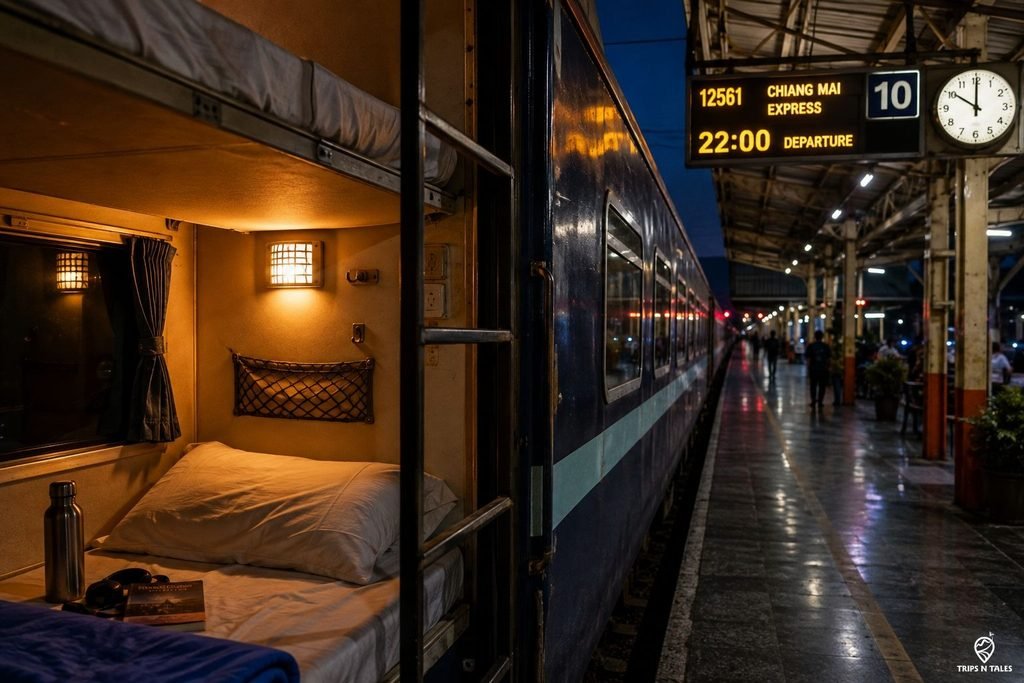
Between cities, don’t sleep on the overnight train (pun intended), it saves you a night of accommodation and it’s honestly one of the more social parts of the trip. Book the second class AC sleeper rather than assuming a flight beats it, once you add in airport transfer time, it usually doesn’t. VIP buses cover most routes comfortably too, and for longer hauls like Bangkok down to the southern islands, just fly. Book trains and buses a few days out during peak season so you’re not scrambling at the last minute.
Safety essentials: transport, accommodation, and common scams
Yes, Thailand is safe for solo travel, with the usual basic precautions. Violent crime against tourists is genuinely rare. The real risks are way less dramatic than what your worried aunt is picturing.
- Road safety comes first. Motorbike accidents are honestly the biggest real risk to tourists here. If you don’t already ride, don’t start on unfamiliar mountain roads just because it looks fun.
- Don’t treat scooters casually. Licensing, experience, a real helmet, insurance, knowing how traffic actually works here, all of it matters more than the cheap rental price makes it seem.
- Watch for the classic tuk tuk scam. Suspiciously cheap ride that somehow includes a stop at a gem shop or tailor? That’s a commission scheme, not a favor.
- The “temple is closed” scam is still alive. Someone randomly tells you a major attraction is closed and offers to take you somewhere else instead? Don’t believe them, verify it yourself.
- Check the meter. Use a metered taxi or a proper ride hailing app rather than accepting a mystery flat fare from whoever flags you down.
- Grab is your friend, especially at night. Easier to track, no haggling required.
- Lock up your valuables. Use hostel lockers, don’t leave your passport and cash lying around “just for a second.”
- After dark, stick to what’s lit and busy. Skip the empty back streets, take a proper ride hailing service over hopping into a random unmarked car.
- Keep the essentials within reach. Charged phone, ID, a way to pay, your accommodation address, all accessible without digging.
- Solo female travellers, add one more layer. Double check accommodation reviews, think through your nighttime routes, know local customs before you land. A little extra prep goes a long way.
Solo travel versus group travel in Thailand: the honest trade offs
Going fully solo means total control, your pace, your budget, your route, nobody else’s schedule to argue with. That freedom is genuinely one of the best parts of traveling alone, anywhere.
But here’s what people don’t warn you about: the logistics get old fast. Booking every train leg yourself, making every single decision solo day after day, and that inevitable stretch where you get sick or lonely with nobody around to help you through it. None of it’s dangerous exactly. It’s just draining in a way that creeps up on you a few weeks in.
That’s exactly where a small group trip earns its keep, not as a comfort upgrade, but as a real fix for a real problem. Shared transport costs, someone else handling the train bookings and route planning, an instant social circle from day one, while you still get plenty of room to wander off solo whenever you feel like it.
How TripsNTales’ Thailand trip solves the hardest parts of going solo
A well planned circuit through Bangkok, Chiang Mai, and the islands basically mirrors what independent travellers end up piecing together anyway, minus the headache of booking every sleeper train and songthaew yourself. This isn’t the only way to do Thailand solo, plenty of people go fully independent and have an incredible time. But for a first trip, it cuts out the parts that burn people out while keeping everything that made going solo appealing in the first place.
Trips N Tales runs exactly this through Thai Escapes, built for people who want the logistics sorted without losing the adventurous, social energy that made a solo trip sound exciting to begin with.
Real details worth knowing before booking anything
Overnight trains save you a night of accommodation and double as one of the more social parts of the trip. Book that second class AC sleeper rather than assuming a flight wins, once you factor in getting to and from the airport, it usually doesn’t. SIM cards matter from hour one, not just for maps, Grab genuinely won’t work without one. Street food and food court culture make solo dining a complete non issue here, nobody blinks at a table for one, it’s just how half the country eats every day. And the real difference between “tourist trap” and “feels local” often comes down to the neighborhood more than the city itself, Khao San Road and Ari are basically different worlds despite being a short BTS ride apart.
A simple two week first timer route
Bangkok (3 days) → overnight train to Chiang Mai (4 days) → Pai (2 days) → flight to Koh Tao or Koh Phangan (4 days) → back to Bangkok to fly home.
Packing checklist:
- Passport valid six or more months beyond your travel dates
- Local SIM sorted on arrival
- Power bank
- Padlock for hostel lockers
- Lightweight scarf for temple visits
- Comfortable walking shoes
- Basic medical kit and travel insurance documents
Before booking anything
Solo travel in Thailand comes down to three things: a realistic budget, a route that hits the highlights without rushing, and being honest with yourself about whether full independence or a small group circuit is actually the trip you want. Either one works beautifully here. Thailand’s infrastructure makes both genuinely easy, which is exactly why it stays one of the best places on earth to start solo travel, or come back to it again and again.
Curious what a small group circuit through Thailand actually looks like? Check out Thai Escapes, or browse the full Trips N Tales trip calendar for everything open right now.
Frequently asked questions
Yes. Violent crime against tourists is rare, and the country has decades of backpacker infrastructure built specifically for independent travellers. The real risks worth planning around are motorbike accidents and predictable tourist scams, both easily avoided with basic awareness.
Backpacker style travel runs $25 to $40 USD a day, covering hostel dorms, street food, and local transport. Mid range travel with private rooms and more comfortable transport sits closer to $50 to $100 USD a day.
Two weeks covers Bangkok, Chiang Mai, and one island properly without rushing between them. Three to four weeks allows for a genuinely slower pace and room to add a stop like Pai.
November through February offers the coolest, driest weather across most of the country, though it’s also peak season with higher prices. June through October is the rainy season and the most affordable, with rain usually limited to afternoon downpours rather than washing out entire days.
It depends on the traveller. Full independence offers total freedom over pace and route, while a small group trip removes the logistics load, transport bookings, route planning, decision fatigue, while still leaving room for solo exploration during free time.
One Response