
Direct Answer
Bali suits travelers who want a packed mix of beaches, waterfalls, culture, islands, adventure, and scenery across Bali, Gili and beyond. Thailand suits travelers who want cities, islands, nightlife, nature, and plenty of variety packed into one trip. Neither one is objectively “better.” It comes down to what kind of week you actually want.
- Thailand is visa-free for Indians (30 days, effective September 15, 2026); Bali needs a paid e-VOA
- Thailand flights from India are shorter and generally cheaper
- Bali works well for travelers who want a mix of island life, adventure, scenery, and culture
- Thailand works well for multi-stop trips, nightlife, island hopping, and backpacker budgets
- Their best-weather windows barely overlap, pick your month before you pick your destination
The Group Chat That Never Ends

Okay so your group chat has been going in circles for three weeks now. Someone dropped a poll. Someone’s cousin who went in 2019 has Very Strong Opinions. Someone asked “can we just do both” and got left on read by everyone.
We’re not writing another “top 10 reasons Bali is dreamy” post. Here’s what actually decides this for you: real costs from India, a visa rule that changed literally this month and most blogs haven’t caught up yet, and which trip you’re actually trying to have versus which one just has better lighting on Instagram.
Bali or Thailand: The Honest 30-Second Answer
Bali is one island, but a Bali trip doesn’t have to mean staying in one place. Thailand is a whole country. That’s genuinely most of the comparison once you strip away the aesthetic.
Who Should Pick Bali
If your version of a good trip is mixing beaches, waterfalls, rice terraces, island hopping, adventure and a few genuinely wild experiences into one itinerary, Bali’s your answer. You can go from Ubud’s waterfalls and rice terraces to Gili’s beaches and snorkeling, then keep going into East Java for something completely different. It’s less about sitting in one place and more about packing a lot of different experiences into one trip.
Who Should Pick Thailand
If you want a city, a couple of islands, temples, and street food that changes every fifty meters without applying for three visas or booking three flights, Thailand’s doing all of that in one trip. It’s also just easier logistically, and as of this month, even more so.
Visa and Entry, This Is Where They’re Actually Different in 2026
Thailand’s visa-free rule just changed, and half the blogs online still haven’t updated this. Indians used to get 60 days visa-free. The Thai Cabinet quietly rolled that back. As of September 15, 2026, it’s 30 days, not 60. Still genuinely visa-free, no fee, no application, but you now need the Thailand Digital Arrival Card (TDAC) filled out online within 72 hours of landing. Skip it and you’ll be filling it out at the immigration counter while an entire flight’s worth of people stare at the back of your head.
For a standard 7 to 10 day trip, 30 days is plenty. Only matters if someone in your group was quietly planning to disappear solo afterward.
Bali’s e-VOA isn’t optional, Indonesia just doesn’t offer visa-free for Indian passports. Budget ₹2,500 to 3,000 for the e-VOA plus a separate Bali Tourist Levy of about ₹800 (IDR 150,000) that literally everyone pays regardless of visa type. All in, that’s close to ₹3,300 to 3,800 a person before you’ve even left the airport. Put it in the group spreadsheet now, not as a surprise at immigration.
What Does Each Trip Actually Cost From India?
Flights- Direct vs. Layover Reality
Thailand wins, it’s not close. Bangkok and Phuket have direct flights from multiple Indian cities, 4 to 5 hours, return fares usually ₹16,000 to 35,000. Bali has zero direct flights from India. You’re connecting through Singapore, KL or Bangkok, 6 to 8+ hours total, and fares swing between ₹22,000 and 45,000 depending how last-minute you are (don’t be last-minute with Bali).
Daily Spend, Where Each Destination Quietly Costs More
Thailand runs ₹2,500 to 4,000 a day mid-range, street food is ₹80 to 200 a plate, hostel beds start under ₹1,000. Bali sits higher, ₹3,500 to 5,500 a day, depending on where you’re staying and how much you’re packing into the trip.
The math nobody does: Bali costs can climb quickly when you’re booking private accommodation or adding activities, but the total depends heavily on how you travel. For groups, shared accommodation can change the per-person calculation considerably. So “Thailand is cheaper” is generally true, but it’s not the whole story.
The Vibe Difference Nobody Puts Honestly

Bali is the variety within the destination. One day you’re chasing waterfalls and rice terraces around Ubud, the next you’re snorkeling around the Gili Islands, and later you’re heading into East Java for the Ijen experience. It’s scenic, social and activity-heavy, with plenty of room for beach time in between.
Thailand rewards being a little restless. Phuket, Khao Sok and Krabi can all feel like completely different trips, from boat parties and beaches to rainforest, floating huts and island hopping. Every day can look completely different, which also makes it the better pick when half your group wants nightlife and the other half wants a quiet beach and nobody’s willing to budge.
Best Time to Go, and Why “It Depends” Isn’t a Cop-Out
Here’s the annoying part: Bali and Thailand’s best months don’t overlap. Bali’s dry season is May through September, busiest and driest in July/August. Thailand’s coolest, best window is November through February, basically the opposite half of the year. There’s no single month where both are peaking. Pick your month, then let that pick your destination.
Even within Thailand it’s messier than people admit. Phuket and Krabi (Andaman side) get rain roughly from May to October. Koh Samui and Koh Phangan (Gulf side) run on a totally different schedule, wetter months later, September to December. So “the best time for Thailand” actually depends on which islands are on your list.
If your group genuinely can’t decide and wants flexibility to swap closer to the date, April or September are the fairest shoulder-season compromise. Neither destination’s at its best, but neither’s at its worst either.
First Trip to Southeast Asia? That Changes Things a Bit
Bali can be straightforward to plan as a destination, but the kind of Bali trip you choose matters. A Bali itinerary that includes Ubud, Gili and East Java has multiple transfers and experiences to coordinate, much like a Thailand trip that moves between Phuket, Khao Sok and Krabi. Thailand rewards a bit more planning confidence when you’re hopping between regions, but neither destination needs to be complicated if the itinerary is already organised for you.
Mistakes People Keep Making
- Underestimating Bali traffic, Canggu to Uluwatu can eat 90 minutes on a bad day, don’t overpack the itinerary
- Assuming Thailand’s islands are close together, inter-island ferries and flights add real time and cost
- Booking Bali flights late and getting hit with layover-heavy routes at inflated prices
- Not checking which Thai coast your islands sit on before locking dates around “dry season”
- Forgetting the Bali e-VOA and levy are separate costs until you’re standing at the counter doing mental math
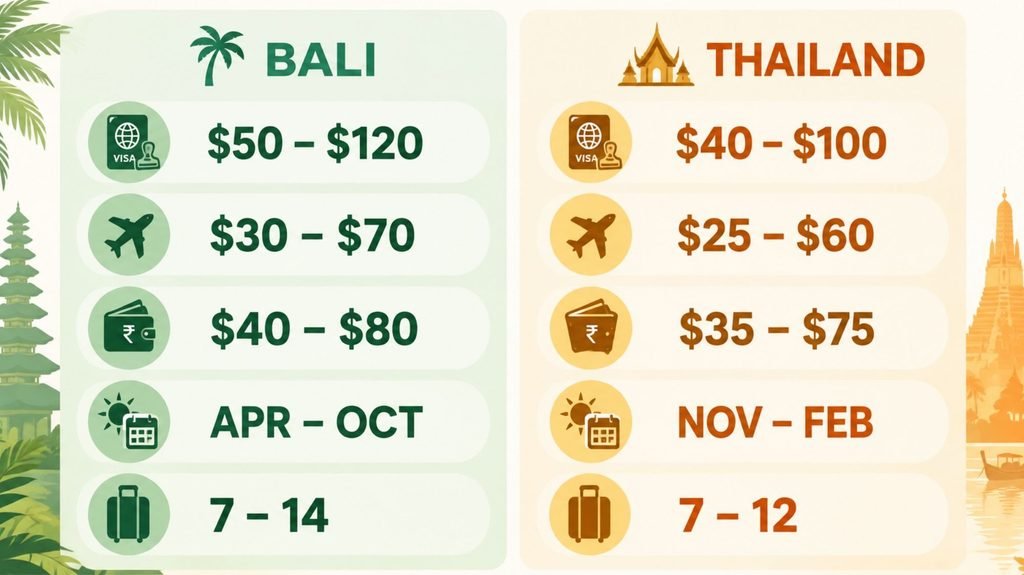
Bali vs Thailand: The Numbers Side by Side
| Bali | Thailand | |
| Visa for Indians | Paid e-VOA (~₹2,500–3,000) + Tourist Levy (~₹800) | Visa-free, 30 days (from Sept 15, 2026) |
| Flight time from India | 6–8+ hrs, usually one stop | 4–5 hrs, direct flights available |
| Return flight cost (approx.) | ₹22,000–45,000 | ₹16,000–35,000 |
| Daily budget, mid-range | ₹3,500–5,500 | ₹2,500–4,000 |
| Best weather window | May–September (peak Jul–Aug) | November–February |
| Trip style it rewards | Multi-stop, adventure, islands and scenery | Multi-city, island-hopping |
| Best for groups | Shared accommodation can help with costs | Often cheaper solo/as a couple |
A Framework, Not a Verdict
Skip the debate and run through these instead:
- One base or multiple stops? One → Bali can work well. Multiple → both Bali and Thailand can deliver, depending on the itinerary
- Anyone in the group allergic to visa paperwork? Thailand removes that step entirely
- Is budget the actual constraint? Thailand generally wins, but your accommodation and group size can change the calculation
- Nightlife or adventure as the spine of the trip? Both can deliver, but the actual itinerary matters more than the destination label
- How many days do you have? Both can work for a week, but check the number of transfers before assuming you’ll have the whole trip to explore
Ready to Actually Book One?
There’s no universal right answer, and anyone claiming there is probably hasn’t run both trips. Match the destination to the trip you actually want, packed with adventure and island experiences or fast and varied across cities, beaches and nature, and lock your month before your destination given how little the weather windows overlap.
Bali calling? The Bali & Gili Islands trip combines Ubud, the Gili Islands and East Java with waterfalls, snorkeling, adventure and the Ijen experience. Thailand, more your speed? Thai Escapes is built around Phuket, Khao Sok, Cheow Larn Lake and Krabi, with island hopping, rainforest adventures and nightlife. Still not sure? The Trip Calendar lays everything out side by side, no group chat poll required.
Frequently Asked Questions
Neither is universally better, it depends on the trip you want. Bali can give you a mix of beaches, waterfalls, islands, adventure and scenery across several stops. Thailand suits travelers who want a multi-stop trip with variety in nightlife, food, nature, and islands.
Thailand is generally cheaper day to day, especially for solo travelers and couples. Bali’s final cost depends heavily on accommodation, activities, transfers and how many stops you include.
Yes for Bali, Indian passport holders need a paid e-VOA plus a separate tourist levy. Thailand is visa-free for Indians, though the allowed stay was reduced from 60 to 30 days effective September 15, 2026.
Bali’s dry season runs from May to September. Thailand’s coolest, driest window is November to February, nearly the opposite half of the year. April and September are the closest thing to a fair compromise if you want decent weather at both.
Both can work well for first-timers. The key is looking at the actual itinerary rather than assuming Bali means a slow villa holiday or Thailand automatically means a complicated backpacking trip. Check how many destinations, transfers and activities are involved before choosing.