
Direct Answer
Planning Egypt? Don’t make the mistake of treating it like a pyramids-and-back kind of trip. Your route should start in Cairo, head south to Aswan by overnight train, follow the Nile to Luxor on a cruise, and then switch ancient temples for Red Sea beaches in Hurghada. Ten stops, one epic route, and absolutely no need to wonder what you’re missing next.
- The pyramids are just the opening act. Keep heading south and you’ll find temples, tombs, local culture and landscapes that deserve their own camera roll.
- The Nile cruise is part of the journey, not just a fancy extra. It’s how you travel between Aswan and Luxor while stopping at some seriously impressive ancient sites.
- Travelling on an Indian passport? Check Egypt’s current e-visa requirements before booking. Processing can take around 5–7 working days, so don’t leave it until the last minute.
- October to April is your comfortable-weather window. December to February is especially popular for Nile cruises, so plan for higher demand.
- Going with a group changes the vibe. Overnight train journeys, sunrise balloon rides and sunset cruise decks hit differently when you’ve got 12–15 people to share the experience with.
Everyone’s Seen the Pyramids. Here’s What They’re Not Telling You About the Rest
The pyramids have basically won the internet. You’ve seen the photos, saved the reels and probably sent at least one to your travel group chat.
But here’s the plot twist: they’re only the beginning.
The real Egypt experience continues south of Cairo, where you can cruise along the Nile, explore temples that have stood for thousands of years, visit a Nubian village and finish the trip with turquoise water along the Red Sea. It’s ancient history, local culture and beach time in one seriously varied itinerary.
The problem with many “places to visit in Egypt” lists? They either stop at Giza or throw a dozen locations at you without explaining how you’re supposed to get between them.
So let’s make this easier.
Think of Egypt as a route rather than a bunch of disconnected destinations: Cairo to Aswan, along the Nile to Luxor, and across to the Red Sea. Once you understand the flow, planning becomes much less chaotic.
Here’s your 10-stop guide, including what to expect, how the route works, what to budget for and the practical details you don’t want to discover halfway through the trip.
The 10 Stops, Quick Version
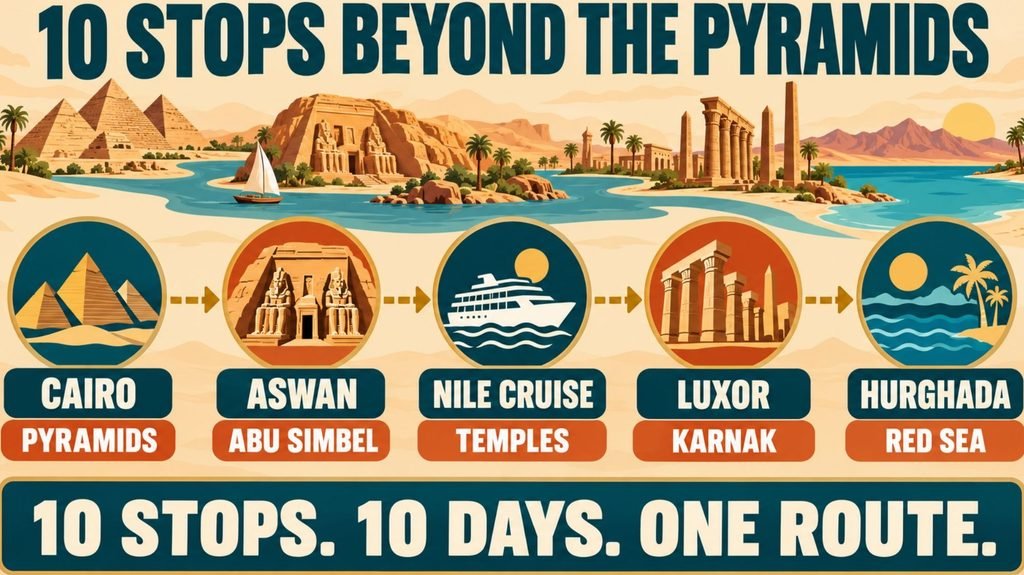
Want the itinerary at a glance before getting into the details? Here you go.
- Pyramids of Giza and the Sphinx — The iconic first stop. Yes, the hype is justified.
- Saqqara and the Step Pyramid — An older pyramid with a fascinating backstory and a different atmosphere from Giza.
- Khan El Khalili Market — Cairo’s bustling souq, packed with spices, lanterns, tea houses and plenty to browse.
- Philae Temple, Aswan — An island temple that begins with a boat ride.
- Nubian Village — A chance to experience a living culture along the Nile, beyond ancient ruins.
- Abu Simbel — An absurdly early start for temples that make you question how ancient builders pulled this off.
- Kom Ombo and Edfu Temples — Nile cruise stops that bring ancient Egypt right into your itinerary.
- Karnak and Luxor Temples — Huge columns, incredible architecture and a grand finale for your ancient-history era.
- Valley of the Kings and an optional sunrise balloon ride — Royal tombs underground, spectacular views from above.
- Hurghada and the Red Sea — Your reward lap: beach time, marina strolls, scuba diving or doing absolutely nothing.
Cairo and Giza: Where It All Starts
Pyramids of Giza and the Sphinx
You’ve seen the pyramids in photos. You’ve probably seen them in films, documentaries and approximately a million social media posts.
And then you finally stand in front of them.
Suddenly, the pictures make a lot less sense. The sheer size is difficult to appreciate through a screen, and all that ancient stone makes you realise just how wild these structures are. The Sphinx might be smaller than you imagined, but seeing it alongside the pyramids is still a proper bucket-list moment.
Give yourself time to take it all in instead of rushing from one photo spot to the next. You’ll want the pictures, obviously, but you’ll also want a moment to appreciate that you’re actually there.
Going with a group? This is usually where your fellow travellers start becoming actual travel buddies. Everyone’s seeing one of the world’s most famous landmarks for the first time, so there’s plenty to talk about beyond the usual “Where are you from?” conversation.
Turns out, shared disbelief is a pretty solid icebreaker.
Saqqara: The Step Pyramid
If Giza is the celebrity of the pyramid world, Saqqara is the fascinating older sibling that deserves more attention.
The Step Pyramid predates the smooth-sided pyramids at Giza, offering a glimpse into an earlier stage of ancient Egyptian pyramid construction. It’s a great stop if you’re curious about how these architectural ideas developed over time.
You’ll also get a different atmosphere here compared with the crowds that can gather at Giza. After the big-ticket sights, a quieter historical site can be a welcome change of pace.
Basically, if ancient Egypt has you asking, “But how did they figure all this out?”Saqqara belongs on your list.
Khan El Khalili Market
Ready for a break from ancient monuments? Head to Khan El Khalili, Cairo’s centuries-old market, where the energy shifts from historical wonder to colourful, bustling chaos.
You’ll find spice stalls, lanterns, tea houses, souvenirs and plenty of little corners worth exploring. It’s a place to wander, browse and soak up the atmosphere rather than speed-run a checklist.
Go hungry if you can. Food stalls and nearby eateries give you another way to experience Cairo beyond its landmarks.
And if you’re planning to shop, get comfortable with bargaining where appropriate. Just remember to be respectful, agree on prices clearly and buy something because you actually want it, not because you’ve become emotionally invested in winning the negotiation.
Aswan: Temples, a Village, and an Early Alarm
Philae Temple
Philae Temple comes with a little bonus before you even arrive: a boat ride to its island setting.
Dedicated to the goddess Isis, the temple is one of the best-preserved ancient sites on this route. Its location gives the visit a different feel from exploring monuments surrounded by city streets or desert landscapes.
Take your time here. The architecture, carvings and setting are all part of the experience, and the boat journey adds a nice change of pace to your day.
If your camera roll is already looking impressive, prepare for more.
Nubian Village
Not every memorable stop needs to involve a temple that’s thousands of years old.
A visit to a Nubian village gives you a chance to experience a distinct culture and community along the Nile. Instead of focusing only on ancient history, you get a glimpse of present-day life and traditions.
That shift matters. Egypt isn’t just a giant open-air museum; it’s also home to people, communities and cultures that exist beyond the monuments on your itinerary.
Approach the visit with curiosity and respect. Listen, learn and remember that you’re visiting a living community, not a photo backdrop.
For many travellers, this becomes one of the most memorable stops precisely because it’s different from the ancient sites.
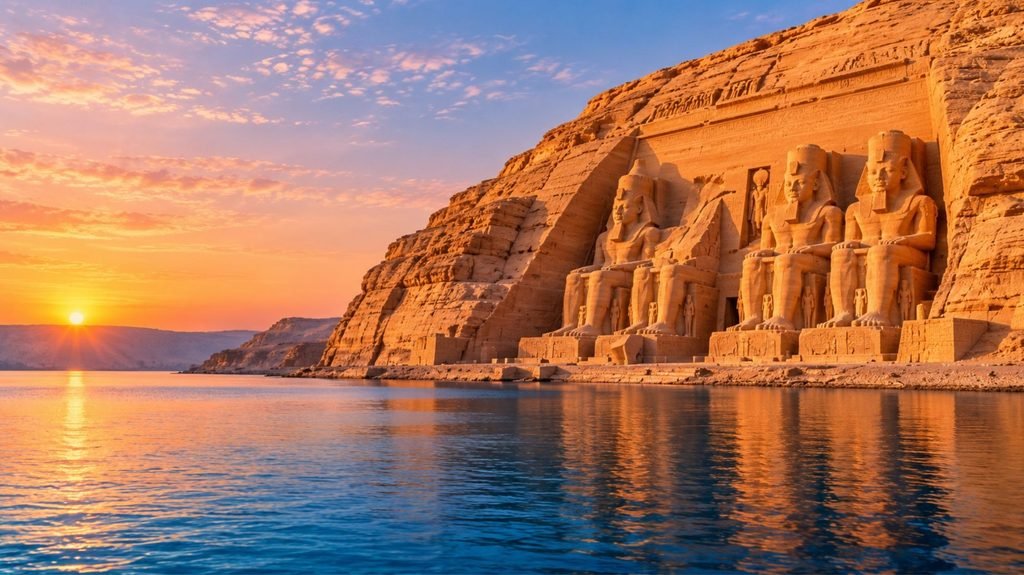
Abu Simbel
Let’s talk about the alarm.
If Abu Simbel is on your itinerary, prepare for an early start from Aswan. The journey takes a few hours, so this is not the morning to stay up scrolling until 2 a.m.
But the temples make a strong case for getting out of bed.
Built under the reign of Ramses II, the monumental rock-cut temples are among Egypt’s most striking historical sites. Their scale and craftsmanship are impressive enough to leave you wondering how ancient builders managed such ambitious projects.
You’ll probably be tired. You’ll probably want another coffee. And you may still decide the early start was completely worth it.
That’s Abu Simbel energy.
On the Nile: What a Multi-Night Cruise Is Actually Like
A Nile cruise isn’t a bonus activity bolted onto the trip, it’s the actual transport method between Aswan and Luxor, and it reframes the whole middle chunk of the route. Instead of buses and station waits, you’re sailing, with temple stops along the way.
Day to day, it looks roughly like this: mornings are for temple visits (Kom Ombo, dedicated to two gods in one building, and Edfu, one of the best-preserved temples in Egypt), afternoons are deck time, watching riverbank life drift by, a dip in the cruise pool, a drink in hand, and evenings often bring onboard entertainment, like local Nubian music, or just hanging out with whoever you’ve bonded with so far.
With a group: this is where a 12–15 person crew actually becomes a friend group. Shared sunset deck time, evening cultural shows, and nowhere else to be for three days does more for group bonding than almost anything else on the itinerary.
Luxor: Egypt’s Greatest-Hits Finale
Karnak Temple and Luxor Temple
Karnak alone could eat a full day, it’s less a single temple and more a sprawling complex built up over centuries, with a hypostyle hall of columns that makes you feel appropriately tiny. Luxor Temple, especially lit up at night, is the kind of stop that photos genuinely undersell.
Valley of the Kings
This is where royal tombs, including, famously, Tutankhamun’s, were cut directly into the rock to avoid grave robbers (it didn’t fully work, but the attempt is impressive). The preserved wall art inside several tombs is genuinely stunning up close.
Optional Sunrise Hot Air Balloon
Not mandatory, but worth strongly considering: floating over Luxor’s temples and the desert at sunrise is the kind of thing that’s genuinely hard to describe and very easy to regret skipping. It’s an add-on cost, not something that comes bundled by default, so budget for it separately if it’s on your list.
Hurghada and the Red Sea: The Reward Lap
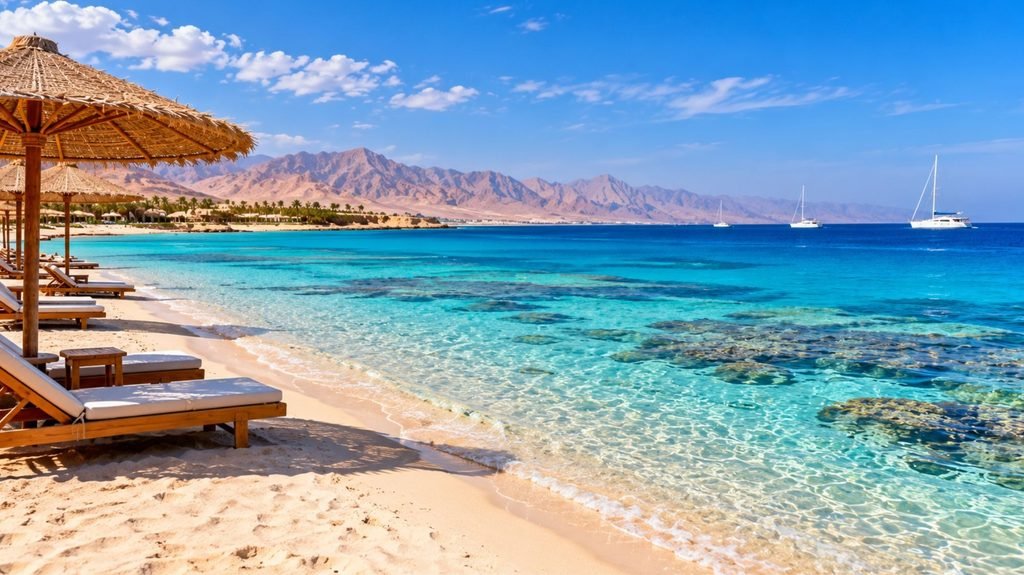
After five-plus days of temples, early alarms, and history, Hurghada is Egypt’s exhale. The Red Sea here is a legitimately different color from anything you’ve seen, turquoise in a way that looks edited even when it’s not, and the Red Sea coral reefs are genuinely excellent for scuba diving, whether that’s a first dive or your fiftieth.
Beyond diving, Hurghada is also just a good place to do nothing, beach days, a stroll along the marina, and a noticeably more relaxed pace than the rest of the trip. After Cairo’s chaos and the structured temple-hopping down south, most people are more than ready for this shift in gear by the time they arrive.
A Realistic 10-Day Route
| Day | What’s Happening |
| 1 | Land in Cairo, meet the group, first pyramid views |
| 2 | Saqqara + Giza Pyramids & Sphinx, overnight train to Aswan |
| 3 | Arrive Aswan, board Nile cruise, Philae Temple, Nubian Village |
| 4 | Abu Simbel (early start), Kom Ombo, cruise continues |
| 5 | Edfu Temple, arrive Luxor, Karnak & Luxor Temple |
| 6 | Optional sunrise balloon, Valley of the Kings, transfer to Hurghada |
| 7 | Scuba diving in the Red Sea |
| 8 | Free day in Hurghada, beach, marina, recovery |
| 9 | Long travel day: bus back to Cairo, final night together |
| 10 | Departure from Cairo |
This mirrors how a well-run 10-day Egypt trip is actually structured on the ground, not a wishlist, a workable route.
Content Gaps: The Stuff Most Guides Don’t Tell You
The overnight train is a real experience, not just a transfer. Giza to Aswan happens overnight on a train, it’s an efficient way to cover a serious distance while you sleep, but it’s also genuinely part of the trip’s character, not a logistics footnote to skip past.
That bus from Hurghada back to Cairo is long. It’s the one unglamorous travel day on the route, usually after a final big night out in Hurghada. Budget energy for it accordingly.
Monument entrance fees during the Nile cruise are often separate from the main trip cost. Site entry fees along the cruise route commonly run somewhere in the $90–100 USD range per person, paid directly rather than bundled in, worth knowing so it’s not a surprise mid-trip.
Heat and crowds both peak around the same months. The flip side of October–April being ideal weather is that it’s also when Egypt is busiest and priciest. Summer is hot but cheaper and quieter, a real trade-off worth weighing based on what you actually prioritize.
Why Egypt Is Genuinely Better With a Group
Solo Egypt is absolutely doable, but there’s a specific kind of magic to doing this particular route with a group of strangers-turned-friends.
An overnight train is just transport alone, with 12 new friends, it’s half the trip’s inside jokes. A 3-night Nile cruise alone is still beautiful; with a group, its shared sunset deck hangs, cultural shows nobody experiences solo, and the kind of bonding that comes from three days with nowhere else to be. Groups typically run 12 to 15 people, with same-gender twin-sharing rooms for solo travelers, so joining solo doesn’t mean traveling solo.
Egypt by the Numbers: What to Actually Budget For
| Cost Area | Typical Range |
| International flights (round-trip from India) | ₹35,000–45,000 |
| Egypt e-visa | ~₹7,500–8,000 (official portal fee is lower; this reflects typical all-in cost) |
| Meals outside included ones | ₹10,000–12,000 |
| Airport transfers (if not included) | ₹2,000–2,800 |
| Monument entrance fees during Nile cruise | ~$90–100 USD (~₹9,000) |
| Optional sunrise hot air balloon | Separate add-on, budget extra |
Trip package pricing changes with early-bird windows and dates, check The Egyptian Escape trip page directly for current pricing rather than relying on a number that may already be outdated by the time you’re reading this.
Do Indians Need a Visa for Egypt?
Yes, most Indian passport holders need an e-visa before arrival; visa-on-arrival isn’t reliably available for solo Indian travelers the way it is for some other nationalities. The process is straightforward: apply through the official portal, visa2egypt.gov.eg, not a third-party site, submit a passport scan and photo, and pay the visa fee online. Processing typically takes about 5–7 working days, so apply well ahead of departure rather than the week before.
Passport validity of at least 6 months is required. If the visa process feels like one more thing to figure out solo, this is exactly the kind of admin a group trip operator can help sort out on your behalf.
Is Egypt Safe to Visit?
Yes, Egypt’s major tourist circuit (Cairo, Aswan, Luxor, Hurghada) is well-established for international visitors, with tourism infrastructure built specifically around these routes. As with travel anywhere, standard precautions apply: stick to organized transport for longer legs like the overnight train and intercity bus, keep valuables secured, and lean on a group leader’s local knowledge for day-to-day navigation rather than winging it solo in unfamiliar areas.
Vegetarian Food in Egypt: Will You Struggle?
Not really, vegetarian options are available fairly widely across Egypt, particularly in cities and tourist-frequented areas. Options can be slightly more limited during specific activities or remote stops (like certain cruise meal settings), but it’s generally not a major planning obstacle for Indian travelers used to seeking out vegetarian meals abroad.
Ready to Actually Book This?
Egypt rewards people who go past the pyramids, the Nile cruise, Abu Simbel’s early alarm, and Hurghada’s reward-lap beach days are where the trip actually becomes a trip, not just a bucket-list photo. And doing it with 12 to 15 new friends instead of solo turns the long travel days into the best parts of the story.
If this convinced you it’s worth it, The Egyptian Escape covers this exact 10-day route. Prefer to ring in the new year on a boat on the Nile instead? New Year’s on the Nile is the festive version of the same trip. Not sure which dates work? The Trip Calendar has everything running this year in one place.
Frequently Asked Questions
Giza Pyramids, a Nile cruise between Aswan and Luxor, Abu Simbel, Karnak Temple, and Hurghada’s Red Sea cover the essentials for a first trip, hitting the major historical sites and a beach stretch without over-packing the schedule.
10 days covers the full Cairo-to-Red-Sea route comfortably, including the Nile cruise. A tighter 7-day version is possible but means cutting either the Red Sea leg or some Luxor sites.
Yes, most Indian travelers need an e-visa, applied for online in advance through the official visa2egypt.gov.eg portal, but visa-on-arrival isn’t a reliable option for most solo Indian travelers.
Yes, Egypt’s main tourist circuit is well set up for international visitors. Standard travel precautions apply, and joining a group trip removes much of the solo-logistics stress for first-timers specifically.
October to April offers the most comfortable weather overall, with December to February being peak Nile cruise season. Summer is hotter but cheaper and less crowded, if that trade-off works better for your schedule.