
Quick answer: Because we know you’ve got twelve tabs open: dry season, April to October, with June through August as the busiest and priciest stretch nobody warns you about early enough. April, May, September and October are your sweet spot months, good weather without the crowd chaos. Six to eight days is genuinely enough to do Ubud, the south coast, and a Nusa Penida day trip properly, without coming home more tired than when you left.

- Dry season: April to October, peak crowds and prices June to August
- Shoulder months (April, May, September, October) offer the best crowd to weather trade off
- Six to eight days covers Bali properly without needing to rush
- Scooters are common but genuinely risky for inexperienced riders, a private driver or organized transport solves most of the hassle
- Indians get Visa on Arrival for IDR 500,000, plus a separate one time Bali Tourist Levy of IDR 150,000
The Actual Planning Problem With Most Bali Guides
Most Bali content does one of two things. Either it sells you the island as a permanent Instagram filter, infinity pools, that one swing, golden hour every single hour, or it buries the actually useful stuff three thousand words deep under twelve paragraphs about “finding yourself.” Wild, we know.
This guide skips straight to the specifics. When to actually go based on real crowd and price trade offs, how many days genuinely make sense, a sample flow through Ubud, the south coast and Nusa Penida, a realistic mid range budget including flights from India, and a straight answer on why Bali might be the one destination where a small group genuinely beats solo logistics. Not because solo travel here is unsafe, just because scooters, boat transfers and split costs behave differently on an island like this.
When is the best time to visit Bali?
Dry season runs April to October, June through August is the busiest and priciest stretch, mostly thanks to the northern hemisphere summer holiday overlap (yes, that’s why every beach club suddenly looks like a school reunion). Shoulder months, April, May, September and October, hit that sweet spot of good weather, manageable crowds, and lower prices.
| Months | Season | Crowds | Prices | Notes |
| April, May | Shoulder (dry) | Moderate | Lower | Good weather, fewer tourists |
| June to August | Peak dry | High | Highest | Northern hemisphere summer holidays, book ahead |
| September | Shoulder (dry) | Moderate | Lower | Often the sweet spot month |
| October | Shoulder (dry to wet) | Lower | Lower | Occasional early rain, prices ease noticeably |
| November to March | Wet season | Lowest | Lowest | Short, often afternoon showers, lush landscapes |
Is the wet season actually worth avoiding?
Not necessarily, honestly. Rain in Bali’s wet season is usually short and predictable, an afternoon or overnight downpour rather than a full day washout, and hotel prices drop noticeably. If cheaper stays and quieter beaches matter more to you than guaranteed sunshine, genuinely consider November through March, especially the earlier and later ends of that window.
What about Nyepi, the Day of Silence?
Once a year, the entire island shuts down completely, including the airport, for Nyepi, the Balinese New Year observance. The Ogoh ogoh parade the night before is a genuinely wild spectacle if your timing lines up. But checking the exact date before booking flights, arriving or departing on Nyepi itself just isn’t possible, no exceptions, no “but I have a connecting flight.”
How many days do you actually need in Bali?
Six to eight days covers Ubud, the south coast, and a Nusa Penida day trip properly, no sprinting between locations or losing a full day to logistics. Those 10 to 14 day itineraries some guides push often just mean bolting on destinations that don’t add much on a first trip, better saved for round two, or extended out to Lombok and the Gili Islands instead.
- Only 5 days? Cut Nusa Penida to a half day or skip it, focus on Ubud plus one south coast base
- 10+ days? Add a Gili Islands extension via Lombok instead of piling on more Bali stops that’ll just feel rushed
A realistic 7 day Bali itinerary
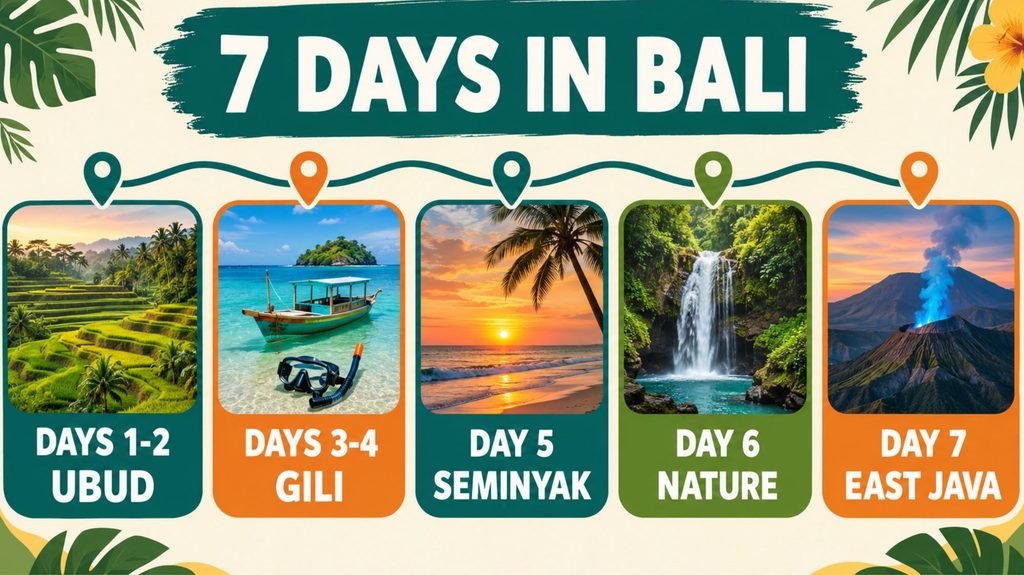
Days 1 to 2, Ubud: Start with Tegallalang Rice Terrace, waterfalls such as Tibumana or Tukad Cepung, local food and some of Ubud’s surrounding sights. If you’re doing an organised trip, this is also where you can fit in the more active experiences without trying to cover the entire island in one day.
Days 3 to 4, Gili Trawangan: Make your way to the Gili Islands and slow down the pace slightly. Spend the day around the water, go snorkeling, explore the island, and take in the famous Gili atmosphere. If you’re up for it, Gili Meno and Gili Air can also be explored by boat. This is the part of a Bali trip that often gets skipped in generic itineraries, even though it’s a major highlight when you’re actually combining Bali and Gili.
Day 5, Seminyak: Head back towards Bali and spend the day around Seminyak. Beach time, cafés, sunset and a night out work better here than trying to squeeze in another long sightseeing circuit. Keep the evening open because this is one of those days where doing less is actually the better plan.
Day 6, Bali’s adventure and nature side: Use the day for one or two experiences rather than five. Depending on your route, that could mean a waterfall, rice terraces, a coffee plantation, or another outdoor activity. The point isn’t to collect locations, it’s to actually enjoy the day without spending half of it in traffic.
Day 7, East Java or departure: If you’re following a longer Bali and Gili itinerary, this is where the route can continue towards East Java rather than treating Bali as the final stop. The Trips N Tales itinerary extends into Banyuwangi and the Mount Ijen experience, including the early morning trek for the crater and blue fire experience. If you’re doing a standalone seven day Bali trip, keep the final morning free for shopping, a beach visit or your departure.
Want this exact circuit, plus a Gili Islands extension, handled without piecing together boats and drivers yourself? That’s what the Trips N Tales Bali and Gili Islands trip covers.
What does a Bali trip actually cost from India?
A mid range 7 day trip, flights, stays, food, activities, local transport, breaks down into a few clear pieces rather than one vague “it depends.”
| Category | What to Expect |
| Return flights from India | Roughly ₹25,000 to ₹60,000+ depending on departure city and season, southern cities like Bengaluru and Chennai tend to run cheaper than Delhi, book 2 to 3 months ahead for better fares |
| Accommodation (7 nights) | Mid range guesthouse or 3 star hotel |
| Food | Mix of warungs and sit down restaurants |
| Activities | Nusa Penida day trip, one temple visit, one class or excursion |
| Local transport | Private driver for full sightseeing days, or scooter rental with proper experience |
| Visa on Arrival | IDR 500,000 per person (roughly ₹2,800 to ₹2,950, about $35 USD), valid 30 days, extendable once for another IDR 500,000 |
| Bali Tourist Levy | IDR 150,000 per person (roughly ₹800 to ₹850, about $10 USD), a separate one time fee paid via the official Love Bali portal, not included in the visa cost |
Flight and accommodation prices shift constantly with season and booking window, so treat the flight figure as a rough planning range, not a fixed quote. Check live prices closer to your actual dates.
Getting around Bali: scooter, private driver, or organized transport?
Scooters are cheap and everywhere, but genuinely risky if you’ve never ridden one, Bali’s traffic density and road conditions don’t forgive learning on the fly. A private driver is the comfier, more efficient call for a full sightseeing day, and ride hailing apps like Grab and Gojek work well in the main tourist zones but flat out don’t operate on Nusa Penida.
Why scooters trip up first timers specifically
Dense traffic, patchy road surfaces, and right of way rules that don’t match whatever calm road back home you’ve been practicing on, it all catches out inexperienced riders fast. Not a blanket “never rent one,” plenty of confident riders do it safely, but Bali isn’t the place to learn from scratch.
Why Bali is a genuine exception to the usual “solo is cheaper” rule
Boat transfers, private drivers and activity bookings in Bali often price per group, not per person, so splitting costs with even two or three other people changes the math significantly, and that’s before you even factor in safety or convenience. That’s exactly why a small group setup here solves a real cost and logistics problem, not just a nice to have.
What do first timers actually get wrong about Bali?
Underestimating travel time between areas trips up more people than anything else, south Bali traffic during peak hours runs way slower than Google Maps promises. Booking accommodation far from the day’s plans adds transit time you didn’t budget for. Treating Nusa Penida as a “quick half day” is another classic miscalculation, boat timing plus the walk down to the cliff viewpoints realistically eats a full day. And trying to squeeze Ubud, the south coast, and outer islands into five days usually means landing home needing a holiday from the holiday.
Real details worth knowing before booking anything
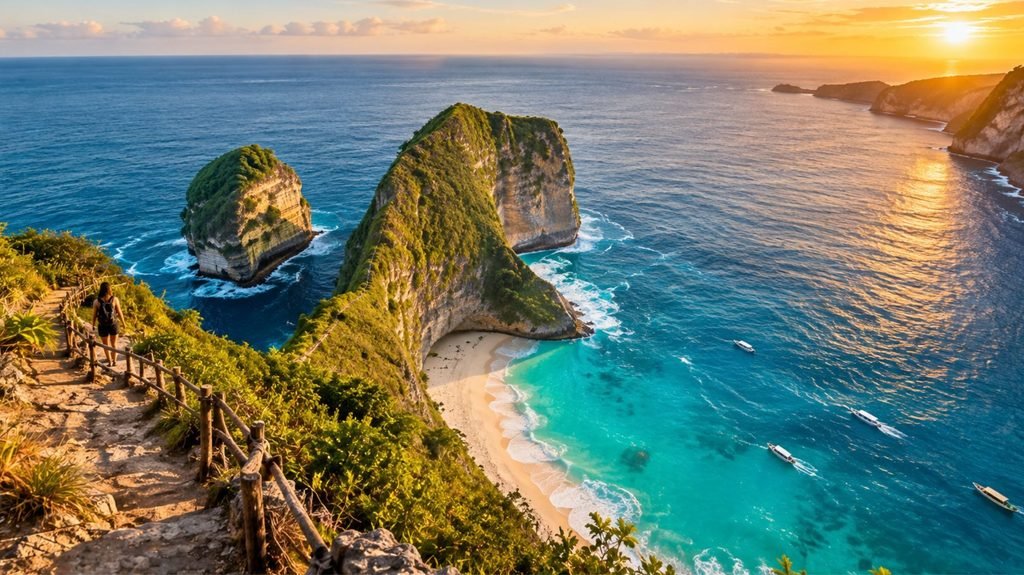
Nusa Penida deserves its own logistics note. Get to Sanur Port 30 to 45 minutes before departure, fast boat schedules run tighter than the app suggests. And since Grab and Gojek don’t work on the island at all, sort onward transport through the boat operator or a local driver in advance, not on arrival.
Common scams are worth knowing by name instead of a vague “be careful” warning. Overpriced taxis dodging the meter, fake fast boat ticket sellers around Sanur and the harbor, and money changers offering rates that sound too good to be true (because they are). All easily avoided by sticking to official counters, hotel recommended transport, and licensed money changer chains.
And yes, the monkeys at temple sites genuinely grab bags, hats and phones. Not an exaggerated warning, they will absolutely swipe your sunglasses mid selfie. Keep loose items zipped away.
Packing checklist:
- Sunscreen, high SPF, reapplied often given the UV index
- Lightweight, quick dry clothing
- Sturdy sandals or sports shoes with grip for Nusa Penida’s viewpoints
- A dry bag for boat transfers
- Power bank
- Modest clothing for temple visits, shoulders and knees covered
- Cash in Indonesian Rupiah for warungs, temple donations, and parking fees
Before booking anything
Dry season, shoulder month timing, six to eight days, and a realistic mid range budget covers Bali properly, no overpacked schedule, no underestimated logistics. Bali’s also one of the clearer cases where a small group trip solves a genuine problem, not a manufactured one, split costs on transfers and drivers, and nobody’s stuck negotiating a scooter rental solo in an unfamiliar place.
For anyone who’d rather have Ubud, the south coast, and a Gili Islands extension handled without piecing together boats, drivers, and bookings solo, the Trips N Tales Bali and Gili Islands trip page has the details.
Frequently asked questions
Yes, but it’s straightforward. Indian passport holders can get a Visa on Arrival for IDR 500,000 (roughly ₹2,800 to ₹2,950), valid for 30 days and extendable once for another 30. It can also be applied for online in advance as an e-VOA for a smoother arrival.
April, May, September, and October offer the best balance of dry season weather, manageable crowds, and lower prices. June through August is also dry but noticeably busier and pricier due to overlapping summer holiday seasons worldwide.
It can suit a range of budgets. Flights from India run roughly ₹25,000 to ₹60,000 return depending on departure city and season, and daily costs for food, activities, and mid range accommodation stay reasonable compared to many other international destinations.
A local SIM or eSIM is genuinely useful from day one, ride hailing apps, maps, and translation tools all rely on a working data connection, and coverage is generally solid across the main tourist areas
Not particularly. The wet season, November to March, brings short afternoon or overnight downpours rather than constant rain, and it comes with real upsides, lower prices and noticeably thinner crowds at the major sights.