
Quick answer: The real decision usually comes down to three things, how much control you want over your budget, how much logistics you’re willing to handle alone, and whether loneliness or compromise sounds worse to you. A group trip for solo travellers works best when the destination is complex or the timeline is tight. Fully independent works best when flexibility matters more than convenience.
- Solo planned trips usually cost less day to day but carry all the risk if something goes wrong
- Group trips for solo travellers bundle transport, permits, and accommodation into one price
- Group trips built for solo travellers rarely charge a single supplement anymore
- Safety nets differ: solo means self managed, group means someone else has a backup plan
- Most experienced travellers eventually land on a mix of both, not one permanently
Ready to skip the debate entirely? The Trips N Tales trip calendar has small group departures built specifically for solo travellers.
The Real Question You’re Actually Asking
Planning a trip alone sounds so iconic, until the practical decisions start piling up. You want the freedom to change plans, stay somewhere an extra afternoon, and set your own pace. But then you think about someone else sorting the transport and stays, and honestly? That sounds kind of dreamy too.
So it’s rarely about which one is “better.” They’re two very different experiences, and the right one depends on what you’re okay compromising on during a two or three week trip.
Three things usually make the answer obvious: cost, safety, and social energy. How much you want to spend, how independent you feel like being, and how much human interaction you want daily will tell you more than any generic listicle ever could (yes, including this one).
Is a solo trip or a group trip cheaper?
Neither wins outright. It depends entirely on the route. Solo travel usually costs less day to day because you only pay for what you use. But a group trip can come out cheaper once permits, private transport and guide fees for a complex route get priced in properly.
What solo travel actually costs day to day
A backpacker style solo budget for most of Asia or India sits around 2,000 to 2,800 rupees a day, covering hostel dorms, local food and public transport. That number climbs fast when the second private transfers, solo dining, or entry fees you’d normally split with a group get added on top.
What gets baked into a group trip package (and is easy to forget)
Group pricing usually bundles permits for restricted regions, private transport between stops, local guide fees, and group rate stays that independent travellers booking one room at a time just can’t get. None of it shows up as a separate line item when you compare your solo daily budget to a group trip’s upfront price, which is exactly why the comparison feels so unfair.
The math most people skip
An eight day tour can look pricey next to a solo daily budget, until you price the same route independently. Transport between every stop, entry fees, a guide wherever permits are needed, and stays at the same standard. Built out fully, the gap shrinks a lot more than you’d expect. Do the actual math before writing off a group trip as the expensive option!
Who handles safety and logistics on each?
Going solo means every single piece sits on you. Train bookings, permits, what happens when a flight gets cancelled. A group trip shifts most of that onto the operator, who has usually already faced the exact same problem before.
What’s on you when you travel solo
Booking trains in peak season, tracking permit rules for restricted regions, and building a backup plan for delays all land on you. None of it is impossible. It just takes real planning and a whole lot of patience with government portals (we see you, buffering wheel).
What a group operator actually absorbs
A decent operator rebooks when things fall through, brings local knowledge that skips the guesswork, and has a trip leader who can act fast when things turn sideways. A cancelled flight, a closed route, a sudden tummy bug mid trip. That’s the stuff solo travellers end up handling completely alone.
A real “what if it all goes wrong” moment
A solo itinerary with five separate flights over two weeks collapses hard if even one gets cancelled and there’s no backup. A group tour facing the same mess usually has the operator rerouting and rebooking on everyone’s behalf, sometimes without you making a single call. Main character energy, minus the stress.
What about making friends on the road?
Solo travel doesn’t mean being alone for the whole trip, but it takes more effort than people think. Group trips front load the social part completely. Instant company from day one.
How solo travellers actually meet people
Hostels with proper common areas, walking tours, cooking classes, and simply staying approachable instead of heads down on your phone all work better than you’d guess. It takes a bit more initiative than a group trip, but it’s rarely as hard as first time solo travellers fear.
Why group trip bonds hit differently
Shared discomfort is a powerful thing. Missed trains, questionable street food, endless travel days. It bonds a group faster and deeper than the usual hostel friendship that lasts a night or two. The flip side? Saying goodbye at the end of a tight knit group trip can hit harder than you expect once everyone scatters home. Consider yourself warned.
The real risk on both sides
Solo travel risks the occasional quiet night in an empty dorm. Group travel risks the opposite: getting stuck with a personality or two that just doesn’t click for two straight weeks. Neither risk disappears completely. They just show up in different outfits.
When does solo genuinely win?
- Full control over your pace, route, and how long you linger somewhere unplanned
- Cheaper on simple, well trodden routes with solid tourist infrastructure
- A better fit if you actually want solitude and self determination as part of the experience, not just a byproduct
- Straightforward destinations where going independent doesn’t need much extra planning
When does a group trip win?
- Complex logistics, multiple flights, required permits, or regions with limited infrastructure
- Destinations where safety and navigation feel like a heavier lift alone
- Tight timelines where covering real ground in a short window matters
- Wanting travel companions from day one without the legwork of finding them
This is exactly where a small group trip for solo travellers earns its spot. Not as a fallback for people who “can’t handle” going alone, but as the smarter call for the trade offs above. Routes like Thai Escapes or Vietnam with Phu Quoc solve this kind of chaos: transport, permits where needed, and a built-in group from day one, while you still get plenty of room to wander off solo whenever the mood hits.
Comparing the two side by side
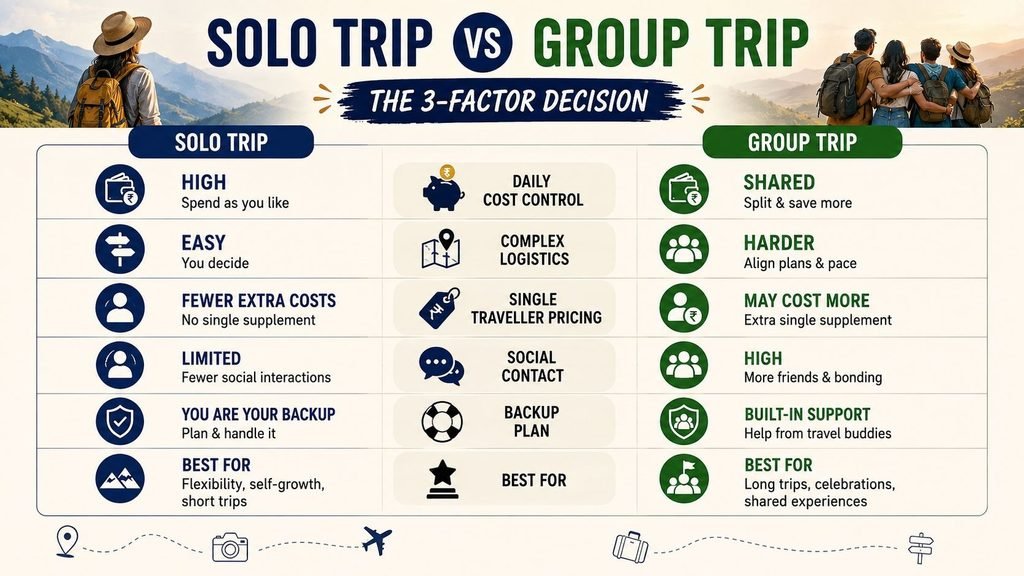
| Factor | Solo Planned Trip | Group Trip for Solo Travellers |
| Daily cost control | Full control, pay as you go | Fixed upfront, less flexible |
| Complex logistics | On you | Handled by the operator |
| Single traveller pricing | Naturally solo priced | Often waived on solo focused trips |
| Social contact | Depends on effort and hostel choice | Built in from day one |
| Backup plan if something goes wrong | Self managed | Operator handles rebooking |
| Best for | Simple routes, experienced travellers, full flexibility | Complex regions, first timers, tight timelines |
Real details worth knowing before booking either
- Group size matters more than you think. Somewhere around 8 to 16 people is the sweet spot. Small enough to actually know everyone, big enough that one mismatched personality doesn’t run the whole show.
- Single supplements used to be the biggest hidden cost for solo travellers joining group tours. That’s changing fast. Plenty of operators now waive the fee on trips built for solo travellers, or pair you with a roommate of the same gender by default. Confirm it directly before assuming!
- Some places aren’t a fair debate at all. Certain destinations legally require a permit or an accompanying guide, which settles the question before you even ask it.
- The hidden cost on the solo side is sneaky. It’s rarely the trip itself. It’s the small stuff adding up quietly: private airport transfers, solo dining, entry fees that would’ve been split three or four ways in a group.
A quick decision framework
- List what the route actually needs: permits, multi leg transport, remote regions with limited infrastructure
- Price out the fully independent version, every piece a group trip would bundle, not just stays and transport
- Be honest about how much energy you have for constant solo decision making versus wanting someone else to handle the plan
- If cost, safety and social all point the same way, that’s your answer. No need to overthink it
Questions worth asking before booking a group trip for solo travellers:
- Is there a single supplement, and can it be waived?
- What’s the group size and rough age range?
- Are the guides local or subcontracted?
- What’s actually included, and what’s paid for separately once you’re there?
- How does the operator handle a cancelled flight or an emergency mid trip?
There’s no universal right answer
Only the right trade off for your trip and your stretch of time. Solo wins on flexibility and cost for straightforward routes. A group trip wins the moment logistics get complicated or the clock gets tight, and you don’t lose the good parts of solo travel either: freedom, spontaneity, and room to wander off alone whenever the moment calls for it.
Already leaning towards letting someone else handle the logistics this time? Browse the Trips N Tales trip calendar for upcoming small group departures, including Backpack Spain and La Tomatina if you’re craving a similar mix of chaos and community a little closer to Europe. Pack your bags, your next adventure is waiting!
Frequently asked questions
It depends on the route. Solo travel usually costs less for simple, well connected destinations, while a group trip can work out cheaper once permits, private transport, and guide fees for a complex route get priced in properly.
Not always anymore. Many operators now waive the single supplement entirely on trips built specifically for solo travellers, or offer a same gender roommate pairing to avoid the fee.
Somewhere around 8 to 16 people tend to work best, large enough to build a real social dynamic, small enough that everyone actually gets to know each other.
Group trips front load the social side from day one. Solo travel takes more initiative, hostels with social common areas, walking tours, and staying approachable all help, but the connections often happen more naturally over time.
Yes, and plenty of experienced travellers do exactly this, booking a group trip to anchor the more complex or logistically heavy part of a route, then travelling independently on either side of it.